
What IP67 and IP68 actually test
A buyer comparing two lamps will usually take the bigger IP number as the safer one. It is a reasonable assumption, and it is wrong often enough to be worth ten minutes.
Look at a 4WD with our parts on it and you will find three different IP numbers, none of them the same.
The switch panel on the dash is IP65. On most of our panels that is the whole story, but the TC-SWT10 is quoted as “Control box IP67 / Screen IP65”, because it is two enclosures doing two jobs: the box lives under the bonnet and the screen lives where your hand can reach it. The light bar on the bumper is IP67. The work lights are IP68, except one model in the range that is IP67.
Read those as a league table and you will get the wrong idea about all of them. They are not grades. They are the results of different tests, and knowing which test produced the number is most of what the number is worth.
The two digits are two separate tests
An IP rating is always two digits, and they are scored independently. The first is solids, the second is water. IP65 is a 6 for dust and a 5 for water. IP67 is a 6 and a 7.
On anything we would put outside, the first digit is 6 and stays 6. That is the top of the dust scale, and it means dust-tight rather than merely protected. It is not where the interesting differences are.
The second digit is where buyers get misled, because it stops being a scale partway up:
- IPX5 is a jet. A 6.3 mm nozzle sprays the product from every angle for several minutes, and water must not get in far enough to do harm.
- IPX6 is the same idea with a bigger nozzle and a lot more water.
- IPX7 is immersion. The product goes under a metre of water for thirty minutes.
- IPX8 is immersion again, deeper or longer, and the conditions are agreed rather than fixed by the standard. Whoever publishes IPX8 has to say what they tested.
Notice what happens between 6 and 7. The test stops being about pressure and starts being about depth. A product rated IPX7 has been held underwater, but it has not necessarily been sprayed. That is why IP67 is not automatically stronger than IP65 in a car wash, and why the step from IP67 to IP68 tells you about depth and time rather than about force.
None of the second digits above test hot water under high pressure. That is IPX9K, a separate test with its own equipment, and we do not publish it on anything.
Why the panels stop at IP65 and the lamps do not
Once you know what the tests are, the ratings across the range stop looking like a ranking and start looking like a set of decisions.
A switch panel lives in the cabin. It has to pass a loom through its body, shed heat, and let a person press it several times a day with wet hands. Sealing that to immersion standard would mean giving up things the product exists to do, and it would do so for a test case that does not happen, because a dash panel sitting under a metre of water has a much larger problem than its switches. IP65 is the honest answer to the question that actually gets asked, which is whether a wet hand or a leaking window will kill it.
A lamp is the opposite. It is bolted to the outside of the vehicle, it gets hit by whatever the tyres throw up, and on a water crossing it may genuinely go under. So the lamps are sealed to immersion. That is why the light bars are IP67 and the work lights are IP68, with a single IP67 model among them.
The TC-SWT10 is worth a second look because it refuses to pick one. Its control box is IP67 and its screen is IP65, quoted separately rather than lumped into a single figure. A single number would have to be the lower one, which would undersell the box, or the higher one, which would oversell the screen. Two enclosures, two ratings.
What the number on the box does not cover
This is the part worth passing on to your own customers, because it is where the failures actually come from.
The rating covers the lamp, not the loom. A bar tested to IP67 was tested as a sealed unit. The connector you join it with, the splice someone made behind the bumper, the length of cable running up to the switch: none of that was in the test. We have DT connectors available for the bars for exactly this reason. A sealed lamp on an unsealed joint is a sealed lamp with a hole in the circuit.
The rating is a moment, not a lifetime. Every one of these tests is performed once, on a new product. It says nothing about the same seal after four years of heat cycling, UV and gravel. The construction is what carries that, not the certificate.
The rating is not a warranty, and it is not a licence. IP67 describes what a sample survived under defined conditions. It is a useful, checkable claim, which is why we publish it, and it is a different kind of statement from what we will replace and when. Those terms are written into an order rather than stamped on a housing.
What actually keeps the water out
The rating is the summary. The construction is the reason, and there is not much of it to explain.
Every bar in the range has a sealing strip between the housing and the lens. That is the main joint, and it is the one that has to hold.
Some of the bars also carry a breather valve, which is worth understanding because it looks like a hole and it is the opposite of one. A sealed bar heats up while it is running and cools quickly when it is switched off or hits cold water, so the air inside changes volume every time. With nowhere to go, that pressure works on the seal, and cooling air pulls moisture in through whatever gap it can find. A breather valve lets air move and stops water, so the pressure never builds against the joint. If you are specifying bars for a market where they will be run hard and then driven through water, ask which models have one.
High-pressure washing is fine, with one exception. We get asked about this constantly, and in practice the bars handle a pressure washer without trouble. That is field experience rather than a test result: IP67 does not certify jet washing, and nothing in the rating promises it. The exception is the breather valve. Do not park the lance on it. The valve is built to let air through in both directions, and a jet held directly against it is the one thing on the bar you can defeat by aiming at it. Keep the nozzle moving, keep it off the valve, and wash the lens the way you would wash a headlight.
Europe asks harder, and the question is a fair one
European buyers push further on water than most. They ask which test, they ask what the second digit was, and they sometimes ask what happens at the connector. That is the level of question a good distributor asks, and it is the reason we publish the figure the factory has confirmed and leave the field blank where it has not. A rating with nothing behind it is worth less than an empty field, because the empty field at least tells you to ask.
Water is also the failure that actually arrives. Brightness complaints are rare, and the claims that do come back on light bars are wet ones. We have written about why that shapes the way the product is built in what a second row of LEDs really buys you.
What to check before you specify
If you are putting a lighting package together for a customer or a container, four questions cover it.
- Which test produced the number? If a supplier cannot tell you whether their IP68 was thirty minutes at a metre or something they chose themselves, the figure is decoration.
- What is the joint? Decide the connector at the same time as the lamp, not afterwards on the vehicle.
- Does it need a breather valve? Hard duty cycles and water crossings are the case for one.
- Where is the switching going? The lamp rating tells you nothing about what is carrying the current. Our switch panels are IP65 and rated per channel, and that is a separate decision from the lights.
The published rating for every lamp is on its own product page, in the specification table, and the full light bar range is rated IP67. Where a model shows a blank there, it is blank because nobody has confirmed a figure yet, and we would rather tell you that than fill it in.
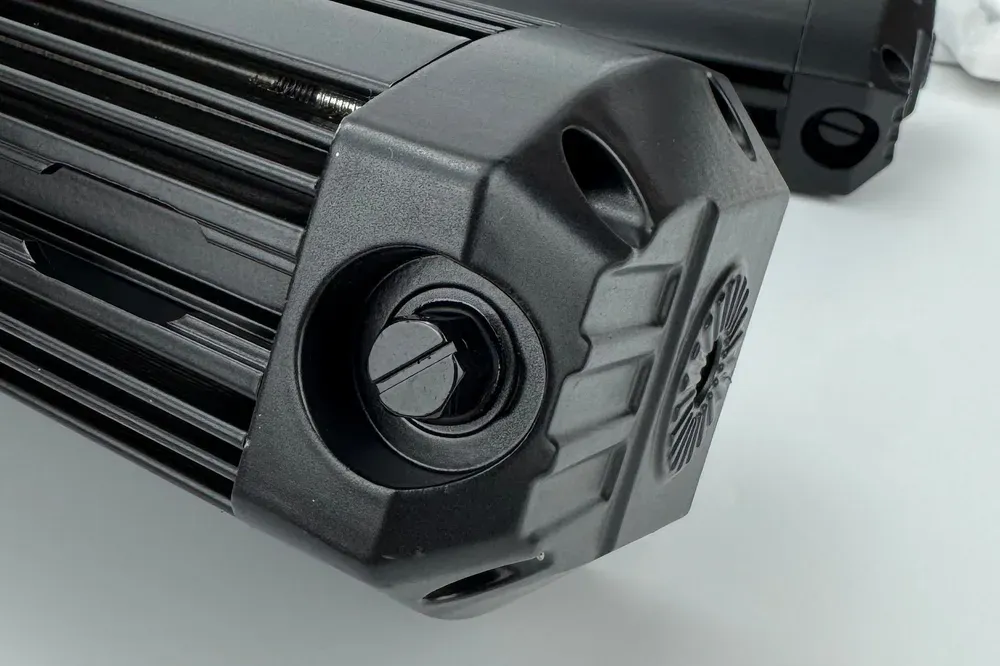
That is the part worth knowing by sight. The ribbed disc set into the cast end cap is the breather valve, the bolt beside it is the mount, and the one thing you do not aim a pressure washer at is the first of the two.
Our FAQ covers the short version of this. If you are sizing a package and want the ratings checked against a specific build, talk to us.