
The 12V side of a hybrid pickup, and what to check before you tap
We build the switching, not the install. The usual accessory-power answer assumes a layout, and on a hybrid pickup there are three things worth confirming before anyone cuts into a loom.
Wiring a pair of auxiliary lights on a diesel pickup has a standard answer. Find a constant feed, find something that switches with the key, put a relay between the two, fuse it close to the source. That answer is old, it is sound, and it quietly assumes the truck is laid out the way trucks have been laid out for thirty years.
Hybrid pickups are new enough that the assumption is worth testing rather than inherited. We build switch panels and control boxes. We do not fit vehicles, and we are not going to tell you where the feed is on your truck. What we can do is set out which facts that standard answer leans on, so somebody establishes them before the trim comes off rather than afterwards.
Why the usual answer assumes a layout
Every step in the standard answer points at a physical thing. A constant feed means a terminal that stays live with the key out. Something that switches with the key means a circuit that drops when you walk away from the vehicle. Fuse it close to the source means you know which source you are close to.
On a hybrid pickup any of those three can sit somewhere other than where habit expects, and the problem that follows is rarely a dead circuit on the day. More often everything works at handover and something is wrong a week later, by which point the trim is back on and nobody connects the two events.
Three things worth confirming first
Where the 12V battery actually is. Owners of the current hybrid Tacoma report that it is not in the engine bay at all, but under a rear seat, which changes where a main feed starts and how long it has to be. See the 4th-gen hybrid accessory wiring thread for how owners describe it. Whether it holds for your truck and your model year is a question for your own documentation rather than for a forum or for us.
What feeds a post that reads 12V. In that same thread an owner describes giving up on an engine-bay 12V post after working out it was fed from the electric motor’s control unit rather than from the battery. This is the one worth sitting with, because a multimeter cannot tell those two posts apart. Two posts can both read twelve volts and change with the key out, and only one of them be a power source.
What the engine-bay fuse box does with the key out. Owners discuss this and do not land anywhere settled. We are not going to supply an answer either, and a page that gave you one from inference would be worth less than this paragraph.
The two questions the forums have not answered
Read enough of those threads and the same two questions keep surfacing without resolution.
The first: does a given fuse box 12V post come straight off the battery, or through a circuit with something else already on it? Owners ask it directly in the battery and accessory wire-in thread and the discussion moves on without settling it.
The second: what does the vehicle manufacturer consider the correct way to wire an accessory on a hybrid, and which taps does it rule out?
Both have real answers, and neither answer lives on a forum or on a supplier’s website. They live in the vehicle’s own electrical wiring diagram, which Toyota publishes through its technical information subscription, and in what a dealer’s technical line will tell you. We do not hold that document. If the job is worth doing properly, that is where the morning goes before any wire gets cut.
Where a factory provision fits, and what decides whether you have one
Some hybrid pickups leave the line with auxiliary circuits already run. Owners report that this is not simply a model question but a trim question: on the thread above, higher trims are described as carrying the harness along with the switches and relays that drive it, while others carry the harness and not the switches.
That ordering matters more than it looks. Whether the factory route is open to you is decided by which truck was ordered, long before anybody opens the bonnet, so it is the first thing to establish and not the last.
What those circuits are rated at, and whether they hold with the key out, we are not going to print. We have not read it in the vehicle manufacturer’s own documentation, and a current rating is the kind of number that decides whether a light bar is safe on a circuit. Get it from the wiring diagram.
The battery route, and which battery
Owners are already fitting eight-gang panels to hybrid pickups, and the threads are about where the feed starts, not about the panel. Which battery, and which post on that battery, is what gets argued over.
The trouble owners describe attaches to which 12V point the feed was taken from rather than to the relay approach itself. Some of the 12V posts and fuse positions in an engine bay belong to the hybrid system’s own circuits, and those are the ones the reports cluster around. That is a useful distinction if you are quoting the job, because it means the method is not the thing that needs checking, the choice of origin is.
None of this involves the high-voltage system, and the two should not get spoken about in the same breath. Never touch the orange high-voltage cabling. It is not an accessory feed, there is nothing on it to tap, and it is not something to probe or test looking for one.
Two things are worth carrying into any install, hybrid or not.
A fuse tap borrows a circuit that already has a job. One owner found that a device sharing the circuit stopped working once the switch system was live, and that giving the tap its own fused pair fixed it. The circuit was never idle, it just had slack until something else wanted it.
Seal the firewall hole the same day you drill it, not next weekend. Our 8-gang wiring guide covers how that crossing should be made, and it is the same discipline that keeps water out of a sealed light bar housing.
What goes between the tap and the loads
Once the origin is settled and you know what it is rated for, the question changes shape. The practical problem becomes how many circuits that one origin can carry, which is an arithmetic job rather than a hybrid one.
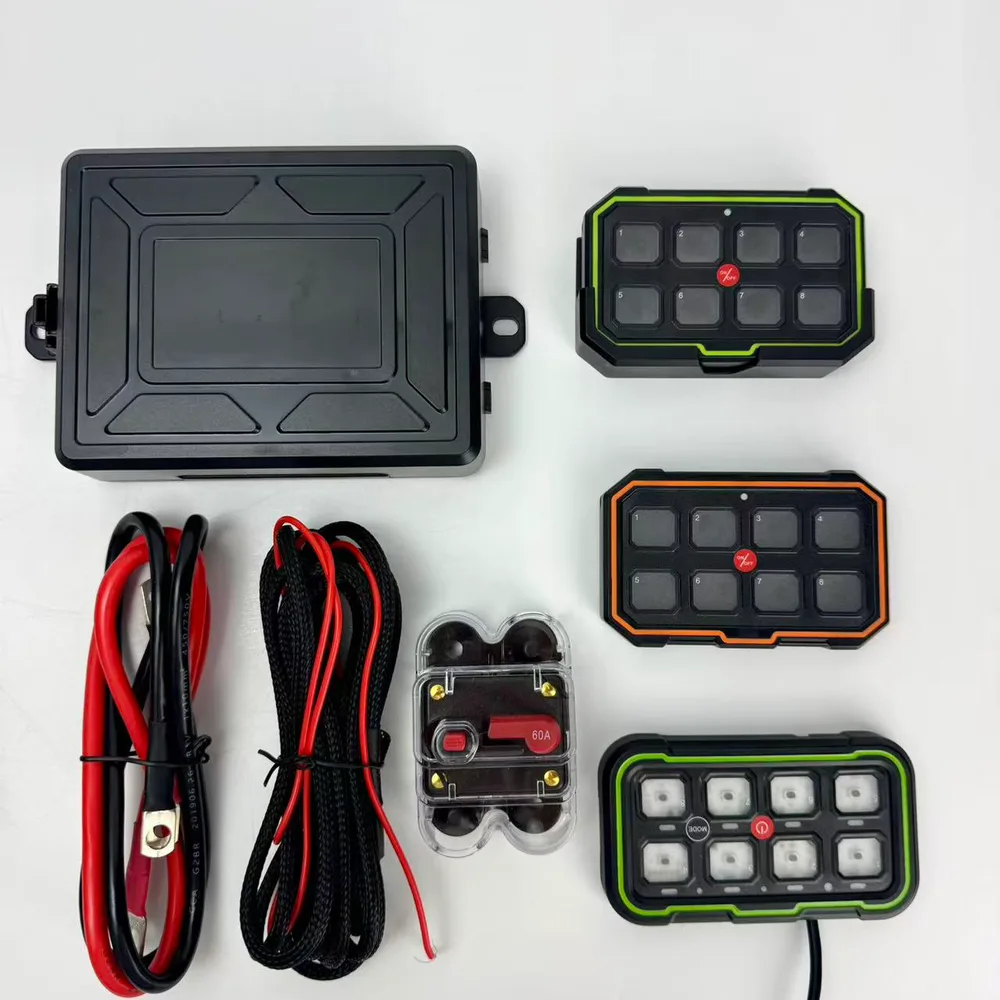
That is the job a control box does. One feed from the origin to a box, the loads wired at the box, and only a signal cable going forward to the dash panel. Eight circuits do not mean eight runs through the firewall.
On the TC-SW8W and the wired TC-SW8B, the eight channels are rated individually: two at 30A, two at 20A, two at 10A and two at 5A, 60A total across the panel, on 12 to 24V DC. Switching is solid state, so there are no relay contacts to pit, weld, or chatter on corrugations. Sizing by total current rather than by switch count is the part most builds get backwards, and it is worked through here.
Three things about fitting the box, since engine bay room is usually what runs out first.
- Plan the space at 190 mm, not 150 mm. The body of the control box is 150 mm wide and the mounting tabs stand wider than the body. The tabs are what it gets screwed through, so 190 mm is the figure that decides whether it fits the spot you picked.
- The antenna is a separate part. It is a 150 mm magnetic whip on a 2 m lead rather than a stub on the lid, which is what lets the box live somewhere buried while the antenna sits where it has a clear path. The installation guide shows where each piece ends up.
- The kit arrives with a 60A breaker for the feed, so that part of the job is not a separate shopping trip.
One point worth being exact about, because wireless invites the wrong conclusion. The remote panel runs on its own 1500 mAh cell, which is charged separately and never draws from the truck’s 12V. The control box is not wireless and still takes its power from the truck, exactly as the wired panels do. Nothing about choosing the remote changes what the box draws.
The short version
Before anybody cuts a wire on a hybrid pickup, have four answers written down: where the 12V battery is, what feeds the post you were planning to use, whether the truck carries a factory provision, and what the circuits you are borrowing are rated at. The first two come from the vehicle’s wiring diagram. The third comes from the build sheet. The fourth is what decides whether the lights you picked are safe on the circuit you picked.
None of that is switching, and none of it is something a panel solves for you. What a panel changes is the arithmetic afterwards, because one confirmed origin feeding a switch panel goes a lot further than four unconfirmed ones.
If you sell our panels, this page is written to be forwarded. The panel side does not change on a hybrid. The work is in confirming where the feed comes from, and that is what this guide walks through.